
Every financial decision comes with tradeoffs. Whether it is deciding which investment accounts to open, how to invest your money, or whether to invest at all, every financial decision comes with its tradeoffs. These options always come with alternatives, and each option has its own benefits.
Opportunity cost is the value of the next best alternative that you give up when making a decision. For example, if you have extra money, do you invest that money or spend that money on leisurely items? If you choose to invest that money, the opportunity cost might be life experiences you could enjoy today. If you choose to spend it, the opportunity cost is the future value that money could have generated for retirement.
As investors, we need to be intentional with where we save our money and where we spend it. The challenge lies in how to balance both spending and saving. Is it possible to be able to save how we want, and still live the life we want to live?
What Does Financial Balance Look Like?
What is financial balance? Think of financial balance as the middle ground between saving too much and spending too much. Financial balance refers to investing to achieve long-term goals, while still meeting your current needs/priorities in life. Examples of financial goals include maintaining an emergency fund, investing regularly into retirement accounts, and paying off debt. Finding financial balance will help us maintain goals for retirement while still taking our desired vacations and doing the activities we strive to do, whether that be with family or friends.
What is the danger of saving too much? Saving aggressively can ultimately set you up for retirement, or even early retirement if we are aggressive enough with our savings. On the surface, that sounds great; however, we need to consider the cost of focusing solely on the future. Saving too much can affect our present lives. How many events, vacations, or opportunities will you miss out on if your eyes are only set on retirement? Focusing on just your retirement may come at the expense of meaningful experiences in your 20s, 30s, and even 40s.
The opposite extreme can be just as harmful. Spending too much money now can affect how our retirement looks down the road. If we spend too much and save too little, we can force a later retirement than originally expected or wanted. The goal of financial balance is to find a lifestyle that allows you to both save how you want for retirement while also allowing you to spend money in a way that fulfills your current lifestyle.
Steps To Take To Achieve Financial Balance
Now we have to ask ourselves, what are the steps we can take to achieve financial balance? As investors, how can we be prepared for retirement and still live comfortable and fulfilling lives today?
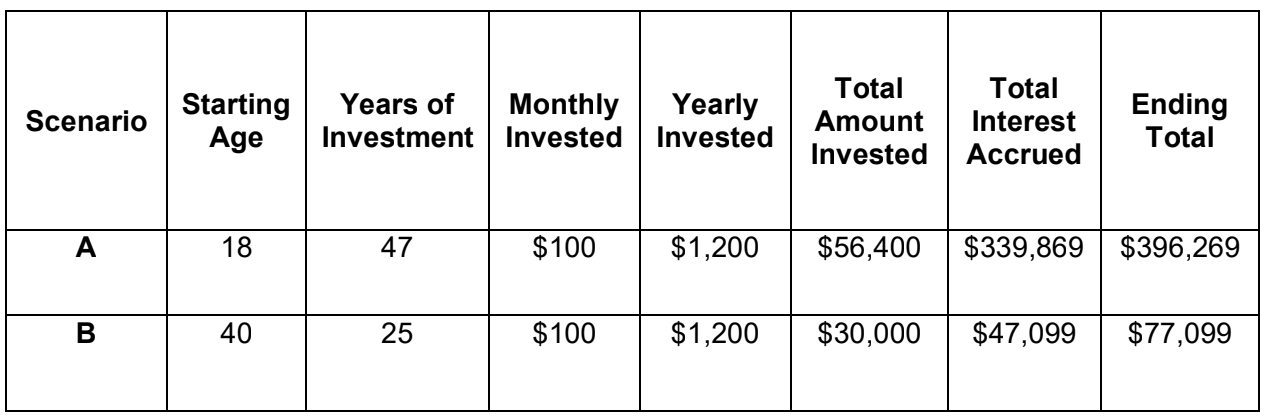
The first step is to start investing early. One of the most powerful tools in investing is time. The more time you allow yourself to have market exposure, the more investment gains your account will receive. Those gains will come from compound interest. Compound interest is the earned interest on both the money you contribute and the interest you have already earned. The idea of compound interest is to use time to your advantage. The more time you have in the market, the more time your contributions and accumulated interest have to earn additional interest. The chart below shows two different scenarios. Scenario A is the proactive investor who starts young and contributes until retirement, and Scenario B is the procrastinating investor who started investing at 40. Both scenarios assume both investors are investing $100 a month into a Roth IRA at the beginning of each month, and both investors receive a 7% return each year until retirement at 65.
This chart is for illustrative purposes only. Returns are not guaranteed.
This chart illustrates the power of investing early. As an investor, you do not need to put an abundance of money away to stay on track with retirement. If you start early with $100 a month, you can retire with almost $400,000 in just your Roth IRA. Starting early allowed the investor in scenario A to contribute only $26,400 more than scenario B investor, but scenario A investor ended with more than $319,000 of additional wealth. Investing $100 a month allows you to put money aside without putting you at risk of saving too much.
The second step is to establish a relationship with a financial advisor. Financial advisors specialize in guiding clients through their complex investment journey and help clients make informed decisions along the way. Whether the decision involves saving, spending, or investing, financial advisors provide education and guidance to you to allow you to make the most informed decision for yourself with confidence. One of the primary tools financial advisors will use is a financial plan. This plan is used to map out where you are currently, where you want to be at retirement, and what steps need to be taken to get to where you want to be. In that financial plan, advisors will map how much you make, how much you spend, and how much you save. Using that information, the advisor will be able to build a simulation to show you exactly what your financial picture looks like using that specific information. Based on the visual, you may have to make changes to ensure you are still on track for retirement.
In addition to working with a financial advisor, you will also want to create a type of budget for yourself so you can track your money coming in and money flowing out. Budgeting sheds light on your spending and saving habits, and this helps ensure that your current habits are still aligned with future goals. Budgets are incorporated into financial plans, created by the advisor, and it serves as your own personal accountability tool that helps balance present enjoyment with future financial goals. I know personally, seeing exactly where my money is going helps me plan for the future.
Should I Save Now or Later?
At the end of the day, you as the investor have to do what is best for you and your situation. Even with a financial plan, a budget, and information regarding the time value of money, only you can decide to invest and if so, how much to invest. As an advisor myself, I am biased and believe starting early, even if contributions are “small” is more beneficial than not investing at all. You can invest small relative amounts to your checks and still be present in your current life. If you want to start investing, or do not know where to start, contact us at Aurora at (765)-450-7087, or message me directly and I’d be happy to assist.
Alex Watkins
(765)-560-5344 - Office
(765)-480-8550 - Cell